

Communication Styles in Relationships: A Guide to Better Connection
Imagine your relationship as a dance: each partner brings a unique rhythm, pace, and style. When both dancers sync, the result is effortless harmony. But if one leads too strongly or the other hesitates, stepping on toes becomes inevitable. Understanding communication styles in relationships is like learning the steps: once you know your moves and your partner’s, you can glide through conversations rather than stumble through conflicts.
Whether you’ve faced misunderstandings, experienced a painful breakup, or simply want to strengthen your bond, grasping the nuances of how you and your partner interact is essential.
In this guide, we’ll explore different communication styles in relationships, illustrate types of communication styles, and offer practical tips to transform how you connect.
Why Communication Style Matters in Relationships

Your default style shapes every conversation, from small decisions to major conflicts. Research shows that mismatched communication styles in relationships drive 65% of all couple arguments [1].
When one partner is constantly avoiding (passive) and the other is demanding (aggressive), resentment or withdrawal build over time. By recognizing your style, you can adapt to your partner’s needs, reduce unnecessary friction, and deepen empathy.
The 4 Communication Styles Explained
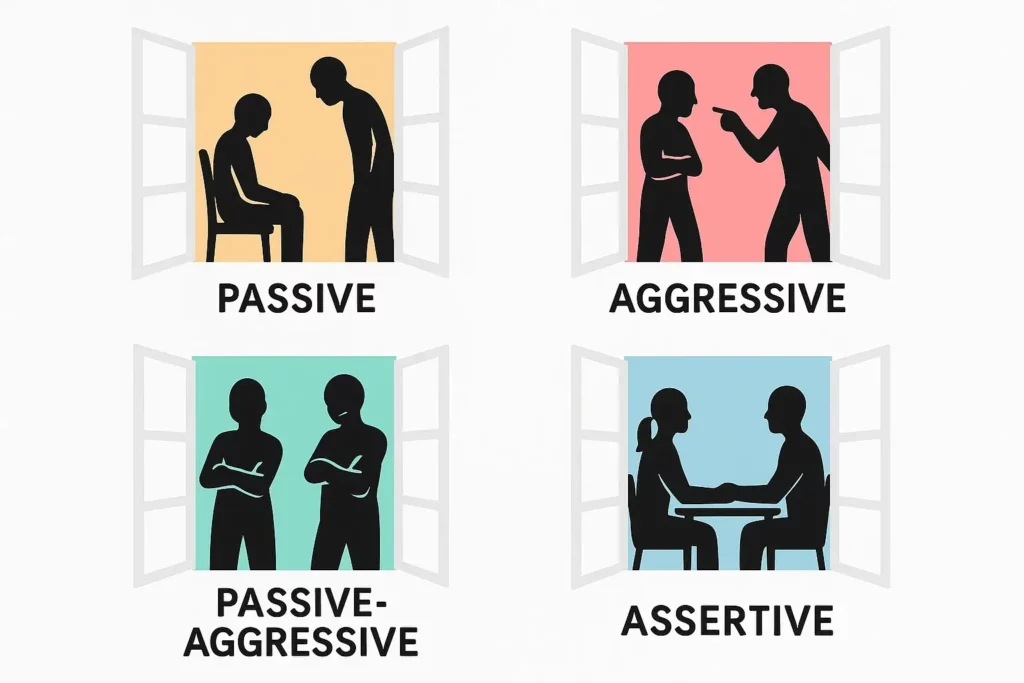
Experts identify four communication styles that people habitually use:
1. Passive Communication Style
People who default to a passive communication style often prioritize keeping the peace over expressing their true needs. In communication styles in relationships, this manifests as softly agreeing to plans they dislike or deferring to their partner on decisions large and small.
You might find yourself saying “I’m fine” even when you’re not, or apologizing habitually to avoid conflict. Over time, unspoken frustrations build, leading to resentment and a sense that your voice doesn’t matter. Recognizing this pattern is the first step toward speaking up more clearly and preventing the slow accumulation of unmet needs.
2. Aggressive Communication Style
Aggressive communication is driven by a desire to be heard at any cost. An aggressive communicator may raise their voice, interrupt, or use blame-focused language, phrases like “You always…” or “You never…”, to push their agenda.
In types of communication styles in relationships, aggression often feels effective in the moment but damages trust and emotional safety over time. If you notice yourself demanding explanations or insisting on “winning” arguments, you’re likely slipping into this style.
Shifting from aggression involves pausing to consider your partner’s perspective and exchanging “you” statements for “I” statements so that dialogue becomes collaborative rather than combative.
3. Passive-Aggressive Communication Style
A passive-aggressive communication style hides dissatisfaction behind sarcasm or indirect cues rather than outright confrontation. You might praise a completed chore with a sharp tone, “Great job on the dishes…”, or agree to a plan and then sulk, leaving your partner guessing about your real feelings. In different communication styles in relationships, this indirect approach creates confusion and prevents genuine resolution.
The hallmark of passive-aggression is a mismatch between words and tone or behavior. For real-world examples of passive-aggressive communication, notice when someone smiles but rolls their eyes or gives the silent treatment—it’s hostility masquerading as politeness. To move away from hidden hostility, start by naming your emotions aloud—“I’m frustrated that I washed the dishes alone”—so that you transform veiled jabs into honest conversation.
4. Assertive Communication Style
Finally, the assertive communication style represents the healthiest balance of honesty and respect. Assertive communicators use clear “I” statements, maintain a steady tone and eye contact, and invite feedback: “I feel overwhelmed when plans change last minute; can we discuss adjustments together?”, so both partners feel heard. In communication styles in relationships psychology, assertiveness is linked to higher relationship satisfaction and faster conflict resolution.
Practicing examples of assertive communication, such as calmly stating needs or setting fair boundaries, helps couples navigate disagreements without blame loops or power struggles. Over time, adopting an assertive style fosters mutual understanding and deeper connection.
How to Identify Your Communication Style in a Relationship

Pinpointing your default mode among the four communication styles helps you understand why certain conversations feel easy and others feel like minefields. Rather than relying on vague impressions, answer these targeted questions – your responses will reveal whether you tend toward passive, aggressive, passive-aggressive, or assertive communication.
Passive Communication Style
- “When my partner asks for my opinion, do I often say ‘I don’t care’ even if I do?”
- “Do I frequently put my partner’s needs ahead of mine, even to my own detriment?”
What it shows: You may suppress your voice to keep peace, leading to unspoken resentment.
Aggressive Communication Style
- “After a disagreement, do I feel satisfied only if I ‘win’ the argument?”
- “Do I use phrases like ‘You always…’ or ‘You never…’ when I’m upset?”
What it shows: You treat conversations as contests, prioritizing control over collaboration.
Passive-Aggressive Communication Style
- “Do I compliment my partner on something, then immediately add a sarcastic remark?”
- “When I feel hurt, do I give the silent treatment instead of voicing my concerns?”
What it shows: You mask hostility in politeness or silence, creating confusion and tension.
Assertive Communication Style
- “Do I frame my needs with ‘I feel…’ followed by a clear request?”
- “When I set boundaries, do I feel calm instead of guilty?”
What it shows: You balance honesty with respect – key to a healthy, enduring connection.
By journaling your answers for a week, you’ll see patterns emerge. Identifying your style is the first step toward choosing more effective, empathetic ways to connect.
How Different Communication Styles Impact Your Relationship
Compatibility or Friction Between Styles
When two partners interact, their default modes can either mesh or clash:
| Style Pairing | Dynamic & Outcome |
| Passive + Passive | Dynamic: Endless deference—both avoid conflict, so decisions stall.
Outcome: Resentment simmers and emotional distance grows because neither voice can steer change. |
| Passive + Aggressive | Dynamic: One partner demands and asserts; the other withdraws or submits.
Outcome: Power imbalance takes root, with the aggressive partner dictating terms and the passive partner feeling unheard. |
| Passive + Passive-Aggressive | Dynamic: The passive partner stays silent; the passive-aggressive partner sends mixed signals.
Outcome: Confusion reigns—unspoken needs collide with veiled hostility, making real resolution impossible. |
| Passive + Assertive | Dynamic: The assertive partner expresses needs; the passive partner listens but may still avoid voicing concerns.
Outcome: Healthy if the assertive partner patiently invites input; unhealthy if they dominate. |
| Aggressive + Aggressive | Dynamic: Clash of titans—both insist on being heard, often shouting over each other.
Outcome: Escalation and hurt feelings as each tries to “win,” turning simple disagreements into battlegrounds. |
| Aggressive + Passive-Aggressive | Dynamic: Direct attacks meet indirect digs.
Outcome: A toxic cycle—open hostility triggers hidden resentment, poisoning trust over time. |
| Aggressive + Assertive | Dynamic: Assertive partner seeks collaboration; aggressive partner pushes for control.
Outcome: If the assertive partner stands firm with “I” statements, they may rally the aggressive partner toward balanced dialogue; otherwise risk being steamrolled. |
| Passive-Aggressive + Passive-Aggressive | Dynamic: Mutual sarcasm and silent treatments.
Outcome: A relationship built on veiled hostility where real issues never surface. |
| Passive-Aggressive + Assertive | Dynamic: Honest clarity meets hidden jabs.
Outcome: The assertive partner’s direct approach can coax the passive-aggressive partner into openness—if handled with empathy. |
| Assertive + Assertive | Dynamic: Two partners speak openly and respectfully, using examples of assertive communication.
Outcome: Fast, fair conflict resolution and deepened intimacy as both feel equally heard. |
How Mismatches Can Create Power Imbalances
When partners default to different communication styles in relationships, subtle shifts in who speaks up and who holds back can quickly become a structural issue. For example, an aggressive communicator may unknowingly steer decisions and dominate conversations, while a passive partner’s reluctance to assert needs leaves them sidelined.
Similarly, passive-aggressive tactics—like sarcasm or silent treatment—can undermine both honest dialogue and shared responsibility. Even assertive partners can end up carrying the bulk of emotional labor if their directness isn’t met with equal openness. Over time, these uneven dynamics foster resentment: one person feels chronically unheard, the other feels burdened by constant negotiation.
Recognizing these patterns of imbalance is crucial to restoring fairness, ensuring that both voices carry weight in every decision and emotional exchange.
Common Communication Traps Couples Fall Into
- Kitchen-Sink Fights: Dragging in every past grievance until the conversation becomes an overwhelming laundry list rather than a focused resolution.
- Silent Treatment: Using withdrawal as punishment—common in passive-aggressive styles—leaves issues unaddressed and partners guessing.
- Blame Loops: Repeating “You always…” or “You never…” escalates defensiveness, reinforcing aggressive–passive cycles.
- Over-Accommodating: A passive partner’s habit of saying “yes” to avoid conflict leads to built-up resentment and eventual outbursts.
- Victory vs. Resolution Mindset: Aggressive communicators may prioritize “winning” an argument over finding a solution, prolonging conflict.
How to Improve Communication Between Different Styles

Navigating different communication styles requires more than just good intentions—it calls for a diverse toolkit of techniques you can adapt to any conversation. Start with these foundational practices before moving on to advanced methods:
- Deep Listening: Paraphrase your partner’s words—“So you mean…”—to ensure you truly understand before responding.
- “I” Statements: Turn “You never listen” into “I feel unheard when…” to invite cooperation instead of defensiveness.
- Weekly Relationship Huddles: Set aside 10–15 minutes each week to share wins and address frustrations, preventing small issues from escalating.
- Style Mirroring: Gently match your partner’s tone or pace to build rapport, then model an assertive communication style by slowing down and speaking clearly.
- Time-Bound Talks: Agree on a fixed duration (e.g., 10 minutes) for tough conversations to keep discussions focused and respectful.
- Written Check-Ins: If emotions run high, write down your thoughts using examples of communication styles, then exchange notes.
- Monthly Audits: Review your communication journal monthly—celebrate assertive wins
- Third-Party Timekeeper: Invite a certified coach to moderate your conversation, ensuring breaks are taken when needed and respect is maintained.
- Couples’ Workshops or Programs: Enroll in structured courses that provide real-time coaching on types of communication styles in relationships.
By diversifying your strategies, you’ll create an environment where every style feels seen, heard, and capable of evolving toward more positive, assertive interactions.
Communication Styles in Relationships: Final Thoughts
Healthy dialogue is the engine that drives lasting love. When you understand your own patterns and learn to speak and listen with intention, even challenging topics become opportunities to strengthen your bond.
Start by choosing one technique—whether it’s using an “I” statement or scheduling a brief weekly check-in—and notice how small shifts create big changes over time.
Remember, mastering communication styles in relationships isn’t an overnight fix—it’s a journey of mutual growth. If you’re ready to accelerate your progress, our expert coaching at Agape Matchmaking is here to help.
FAQs About Communication Styles in Relationships
What’s the healthiest communication style for couples?
The assertive communication style fosters honesty, respect, and balanced dialogue without aggression or withdrawal.
Can two different styles work well together?
Yes—if both partners learn to adapt. For example, an aggressive communicator can practice pausing, while a passive communicator can practice voicing needs.
How do I change my communication style in a relationship?
Start with self-awareness: journal your reactions, practice “I” statements, and rehearse in low-stakes conversations.
What’s the difference between assertive and aggressive communication?
An aggressive communication style prioritizes the speaker’s needs at any cost, often with blame or demands. Assertive communication style balances honesty with respect and seeks mutual understanding.
Why do I shut down in conflict, and how can I stop?
Shutting down often stems from fear of escalation. Use a break strategy: agree to pause, reflect, and return with a calmer mindset.
Are communication issues a reason to break up or seek help?
Seek help first: many couples rediscover harmony through therapy or structured communication exercises. Breaking up is a last resort when patterns persist despite effort.
Ready for a Better Way to Date?
If you want a relationship built on intention, alignment, and real connection — not dating apps, burnout, or guesswork — matchmaking offers a clearer path forward.
At Agape Match, we help singles identify real compatibility early, so deal breakers don’t turn into years of emotional strain.
👉 Apply to Work With Agape Match
Real connection starts with better systems, not more swiping.

Your success in love starts here.
If you’re ready for a more intentional approach to dating, joining our database is the first step. We’ll get to know you beyond a profile and match with purpose.
Join the Upcoming Live Intensive
Join the intensive.
Work with a matchmaker.
Find your forever.